
Mushrooms



Overview
What Is a Mushroom?
A mushroom is a naturally occurring biological material grown by fungi. People often harvest them from nature or grow them as food or medicine. Technically, a mushroom is neither a plant nor an animal and does not photosynthesize. Its body is built from dense, fibrous cell walls. This physical structure is what gives mushroom ingredients their fiber content and immune-active compounds.
This page explains what a mushroom is, why mushrooms matter in nutrition, how they appear in dog products, and how to read the labels that describe them.
Technically, a mushroom is a dense, solid structure made by a fungus that grows outside its main body and is commonly harvested as food or medicine. The mushroom itself is not the whole fungus. The main body of a fungus is called mycelium, which is a living network of microscopic, thread-like strands that grows through soil, wood, compost, or food. This hidden network absorbs nutrients directly from its surroundings and can spread over large areas while remaining completely out of sight. It is the mycelium that eats, grows, repairs itself, and stays alive long-term.
A mushroom forms when the mycelium gathers part of itself into a dense, organized mass and pushes that mass into open air. Thousands of fungal threads are packed tightly together to create a firm, three-dimensional structure. The mushroom does not gather nutrients or grow roots; it is built using energy already stored by the mycelium.
Mushrooms commonly appear as caps and stems, shelf-like growths on wood, rounded balls, or dense underground structures, depending on species. People harvest mushrooms as foods, supplements, or medicinal ingredients, but biologically they are not vegetables. A mushroom is composed almost entirely of structural fibers and complex carbohydrates, rather than fats or simple sugars.
Because of this physical makeup, mushroom material behaves more like a functional fiber than a calorie-dense food. In dog nutrition, this is why mushrooms are used for immune tone, gut resilience, and antioxidant support, rather than as an energy source. In practice, mushroom ingredients may include material from the visible mushroom, the underlying mycelium, or both, which is why labels, preparation methods, and testing details matter.
Can Dogs Eat Mushrooms?
Some culinary mushrooms are safe for dogs, but many wild mushrooms are not. Safety depends on correct identification and simple prep.
Store-bought types like button, cremini, portobello, oyster, and shiitake are chosen for human food and can be given plain-cooked in water. Skip oils, salt, onions, and garlic.
Yard and woodland mushrooms change with season and location, and some are toxic. Do not allow foraging, and remove lawn mushrooms after rain if your dog is overly interested.
Why Mushrooms Matter in Nutrition
Mushrooms matter in nutrition because of what they are physically made of. Fungal tissues have sturdy outer cell walls built from chitin and beta-glucans (β-glucans). Chitin is a tough, fiber-like material that the body does not digest directly but that can be fermented by gut microbes, similar to certain dietary fibers. Beta-glucans are complex polysaccharides (long chains of sugar molecules) that form part of the same cell wall and are frequently highlighted on supplement labels.
These cell-wall components do more than give mushrooms their firm texture. They are also the source of many of the health-related claims associated with mushroom ingredients. Beta-glucans, in particular, have been widely studied for how they interact with the immune system. Rather than “boosting” immunity in a simple on-off way, beta-glucans help modulate normal immune signaling, meaning they support balanced, appropriate responses instead of overstimulation.
In addition to their structural fibers, many edible mushroom species naturally contain small antioxidant molecules such as ergothioneine and glutathione. These compounds help neutralize reactive molecules involved in oxidative stress, a process that can damage cells over time. Researchers are exploring how these antioxidants may support normal cellular function and contribute to healthy aging.
Overall, many pet parents and supplement formulators look to mushrooms for immune support, gut health reinforcement, antioxidant activity, and overall wellness, even though strength of evidence varies by species and preparation.
Where Mushrooms Appear in Dog Products
Foods and Toppers:
Some dog foods and freeze-dried or gently-cooked toppers use culinary mushrooms—always processed to be dog-safe. These ingredients contribute dietary fiber, prebiotic activity, and a modest amount of phytonutrients. While nutrient levels can vary, they’re often included to support gut microbiome balance and overall immune health.
Supplements:
Mushroom supplements come as powders, chews, capsules, or liquids. Formulas may use:
- Whole-mushroom powders (ground mycelium, fruiting body, or a blend)
- Hot-water extracts standardized for beta-glucan content
- Alcohol or dual extracts targeting specific compounds (often used for species like reishi or chaga)
Labels typically specify the mushroom part used, growth substrate, extraction method, and sometimes beta-glucan percentage. These details matter because they signal the expected potency and help differentiate culinary-type products from supplements intended for targeted effects (e.g., immune modulation, antioxidant support, liver support, or stress calming, depending on species).
Basic Mushroom Anatomy
- Fruiting body: the visible cap–gill/poroid–stem structure that releases spores; tightly packed, wall-dense tissue.
- Mycelium: the threadlike network that feeds the organism; cultivated on wood, on grain, or in liquid culture.
- Hyphae: the microscopic threads that build both fruiting bodies and mycelium.
- Spores: the reproductive units released from the fruiting body; sometimes collected as a specialty ingredient.
Think of a mushroom as a tiny brick city: every cell is wrapped in a wall. What is in that wall explains both how the ingredient behaves and why labels use certain terms.
What Mushroom Cell Walls Are Made Of (and Why Labels Mention Them)
- Chitin: the tough structural fiber that makes tissues firm. In whole-powder products it behaves like insoluble fiber.
- Beta-glucans (β-glucans): branching wall sugars (typically β(1→3) with β(1→6) branches). These are the fungal polysaccharides most commonly measured on labels.
- Mannans / mannoproteins: other wall components; when processed into MOS (mannan-oligosaccharides) they can bind certain microbes and are used in some gut-focused blends.
- Alpha-glucans: storage sugars such as starch or glycogen. Usually low in fruiting bodies but higher when mycelium is grown on grain and milled with that grain (often labeled mycelium on grain or MOG).
Why this appears on labels: a panel that lists % beta-glucans is pointing to the wall fraction most people expect from mushroom ingredients. “Total polysaccharides” can include alpha-glucans (starches), especially in MOG materials. A beta-versus-alpha split gives a clearer picture.
How Cultivation Shapes Composition
How a fungus is grown changes what the final ingredient is made of. Picture three different “grow rooms.” Each produces a different kind of material, and that shows up on labels and in test numbers.
1) Wood or sawdust blocks (fruiting-body focused)
How it’s grown: A sterile block of sawdust or hardwood pellets is colonized by the fungus. When humidity and fresh air are added, mushrooms (caps and stems) push out of the block.
What the material is: Dense fruiting bodies with thick cell walls.
What ends up in products: Dried fruiting-body powders and hot-water extracts that center on wall polysaccharides, especially beta-glucans. Alcohol or dual extracts from these tissues may also carry small, species-specific compounds.
What you might read on labels: “Fruiting body,” “grown on wood/sawdust,” species name, a percent for beta-glucans.
Plain takeaway: Wood-grown mushrooms tend to be “wall-rich,” so beta-glucan numbers usually reflect true fungal wall content.
2) Grain substrates (mycelium on grain, often shortened to MOG)
How it’s grown: Sterile jars or bags of cereal grain (rice, oats, sorghum, etc.) are colonized by mycelium. The mycelium knits the grains together. The entire mix—grain plus mycelium—is dried and milled.
What the material is: Myceliated grain containing both fungal wall material and grain starch.
What ends up in products: Powders labeled “mycelium on grain” or “myceliated grain.” Total polysaccharide numbers can look high because the grain’s starch (alpha-glucans) is counted along with fungal polysaccharides.
What you might read on labels: “Mycelium on grain,” “myceliated [grain],” “mycelial biomass,” “total polysaccharides.”
Plain takeaway: If only “total polysaccharides” is listed, you cannot tell how much is fungal beta-glucans versus grain starch. A split that shows percent beta-glucans and percent alpha-glucans lets you compare MOG to fruiting-body products fairly.
3) Liquid fermentation (broth culture)
How it’s grown: Mycelium is suspended in a stainless-steel tank of nutrient broth with controlled air, pH, and temperature. As it grows, it can release exopolysaccharides into the liquid.
What the material is: Free mycelial fragments and polysaccharides dissolved in the broth.
What ends up in products: “Fermentation polysaccharides” recovered from the liquid and, in some cases, dried mycelial biomass. These polysaccharides are not identical to cell-wall beta-glucans and may be measured with different tests.
What you might read on labels: “Fermentation polysaccharides,” “exopolysaccharides,” “liquid culture.”
Plain takeaway: Fermentation can yield useful polysaccharides, but they are not the same as wall beta-glucans. Check which assay is used and whether any beta-glucan percentage from cell walls is also reported.
How Preparation Directs What Ends Up in the Jar
Different prep methods pull out different parts of the mushroom. Here’s what each one actually means and why labels use those terms.
Whole powdered tissue
- How it’s made: fruiting body or mycelium is dried and milled into a fine powder.
- What it captures: the full “food matrix” — cell walls (chitin, beta-glucans) plus everything inside the cells.
- On labels: “whole powder,” “dried powder,” with the part used (fruiting body or mycelium).
- Plain takeaway: broad but less concentrated; servings are larger to deliver the same amount of measured actives as an extract.
Hot-water extract
- How it’s made: material is simmered/steeped in water, filtered, concentrated, and dried.
- What it captures: water-soluble wall polysaccharides, especially beta-glucans.
- On labels: “hot-water extract,” often with a % beta-glucans and the part used.
- Plain takeaway: the go-to when beta-glucans are the focus.
Alcohol extract
- How it’s made: material is extracted with food-grade ethanol; finished as a tincture or dried extract.
- What it captures: small, alcohol-soluble compound families that vary by species; it leaves most wall polysaccharides behind.
- On labels: “alcohol extract” or “ethanol extract,” sometimes a named marker compound; solvent testing appears on the COA.
- Plain takeaway: useful for small-molecule targets; not a source of concentrated beta-glucans.
Dual extract (water + alcohol)
- How it’s made: water and alcohol steps are run sequentially or in parallel and combined.
- What it captures: both water-soluble polysaccharides and alcohol-soluble families.
- On labels: “dual extract,” with % beta-glucans and, ideally, a second named marker; part used should be stated.
- Plain takeaway: broader coverage, but only as good as the markers actually standardized.
Broth-derived polysaccharides
- How it’s made: polysaccharides are recovered from the liquid of a mycelial fermentation (the “broth”).
- What it captures: exopolysaccharides secreted into the broth; these are compositionally different from cell-wall beta-glucans.
- On labels: “fermentation polysaccharides,” “exopolysaccharides,” or similar; look for the specific assay used.
- Plain takeaway: can be useful, but not interchangeable with wall beta-glucans; compare like with like.
Quick summary for label reading
- Whole powder → broad, food-like, less concentrated.
- Hot-water extract → concentrates beta-glucans.
- Alcohol extract → targets small alcohol-soluble compounds, not beta-glucans.
- Dual extract → aims for both; check which markers are actually listed.
- Broth-derived polysaccharides → fermentation polysaccharides; not the same as wall beta-glucans.
Types of Mushroom Ingredients for Dogs: From Source to Supplement
| Form on the Market | Part and Cultivation | Primary Actives Emphasized | Typical Preparation | Label Should Show | Interpret With This in Mind |
|---|---|---|---|---|---|
| Whole mushroom powder | Fruiting body grown on wood or sawdust | Mixed polysaccharides including beta-glucans; fiber and minerals | Drying then milling | Species and part used; “fruiting body” | Lower actives per gram; servings are larger; beta-glucan % may not be listed |
| Mycelial powder (wood-based) | Mycelium grown on wood or sawdust | Mixed wall polysaccharides | Drying then milling | “Mycelial biomass,” substrate type | Composition varies with substrate; ask for beta-glucans reported separately from alpha-glucans |
| Mycelial powder (MOG) | Mycelium on grain, dried with the grain | Mixed polysaccharides with more alpha-glucans from cereal starch | Drying then milling | “Mycelium on grain,” or “myceliated grain” | “Total polysaccharides” can be starch-heavy; prefer beta vs alpha breakdown to compare fairly |
| Hot-water extract | Fruiting body or mycelium | Beta-glucans and related water-soluble polysaccharides | Aqueous extraction, concentration, drying | % beta-glucans, part used | Good fit when polysaccharides are the focus; look for method clarity and a current COA |
| Alcohol extract | Fruiting body or mycelium | Lipophilic small molecules; many triterpene-type families | Ethanol extraction; tincture or dry extract | Marker compound if standardized; solvent testing on COA | Beta-glucans are not enriched here; dosing centers on the small-molecule marker |
| Dual extract | Fruiting body or mycelium | Beta-glucans plus alcohol-soluble families | Sequential or parallel water and alcohol | % beta-glucans and a second marker when available; part used; solvent testing | Broader capture; verify both the part used and what is actually quantified |
| Broth-derived polysaccharides | Liquid fermentation broth | Exopolysaccharides (secreted) | Broth recovery and drying | Polysaccharide %; fermentation source | Not the same as wall beta-glucans; ask what the assay measures |
Clues You Might Find on Mushroom Supplement Labels
- Species and part used: fruiting body, mycelium, spores, or a blend.
- Growth method: wood, grain (MOG), or liquid culture; this frames any alpha-glucan carryover.
- Preparation: whole powder, hot-water, alcohol, or dual; extract ratios are only useful when paired with a standardized percentage.
- Quantification and testing: look for % beta-glucans, ideally distinct from alpha-glucans. If other markers are emphasized, they should be named. A current COA should confirm identity, microbial limits, heavy metals, and residual solvents where applicable.
Pulling the Pieces Together
Anatomy explains extraction, and extraction explains labels. Fruiting bodies are wall-dense and suit hot water for beta-glucans. Mycelium can be grown on wood, grain, or in liquid; grain-based MOG brings alpha-glucans that change “polysaccharide” numbers. Alcohol preparation favors small, lipophilic compounds. When a label tells you the part, growth method, preparation, and beta-glucan percentage, you can see what is in the jar and why two products that both say “mushroom” may behave differently.
Safety and Good Sense
Introduce new mushroom ingredients gradually with food. Watch stool quality, appetite, and energy during the first one to two weeks. Check with your veterinarian before use if your dog has an immune-mediated condition, is on anticoagulants or immunomodulators, has diabetes, or has surgery planned. Favor products that name the species and part used, state the preparation, and can provide a current certificate of analysis.


Food Component Groups
 Ingredient sources group of Mushrooms
| Image & Title | At a Glance |
|---|

Foods
Types of Mushrooms
| Image & Title | At a Glance |
|---|---|

|
Chaga (Inonotus obliquus) is a medicinal mushroom that grows primarily on birch trees in cold, northern climates. It is naturally rich in polyphenols, melanin, and antioxidant compounds that are studied for their role in supporting cellular resilience and oxidative balance. Chaga is commonly used in supplemental form as a concentrated extract rather than as a whole food. |

|
Cordyceps mushrooms are a distinctive type of fungus that, in the wild, grow from insect larvae rather than soil or wood, producing thin orange fruiting bodies. Because this natural form isn’t suitable for widespread supplement use, nearly all Cordyceps used today is cultivated on plant material in controlled environments. Cordyceps appears in dog supplements for bioactive compounds such as cordycepin and adenosine, which are studied for their roles in supporting energy metabolism, stamina, and immune balance. |

|
Lion’s Mane mushrooms (Hericium erinaceus) are a distinctive white fungus that grows on hardwood trees and forms soft, cascading spines instead of caps. They contain natural compounds such as hericenones and erinacines, which are studied for their potential to support brain and nerve health. In canine nutrition, Lion’s Mane appears in supplements formulated for cognitive function and healthy aging, and is considered safe for dogs when used in extract form under veterinary guidance. |

|
Maitake mushrooms (Grifola frondosa), also known as Hen of the Woods, are large, ruffled fungi that grow in clusters at the base of hardwood trees such as oak. They contain complex beta-glucans, including a well-studied compound called D-fraction, which has been researched for its effects on immune and metabolic health. In canine supplements, Maitake is used to help support balanced immune function and vitality, and is considered safe for dogs when used in extract form under veterinary guidance. |

|
Reishi mushrooms (Ganoderma lucidum) are glossy, reddish-brown fungi that grow on hardwood trees and are known for their dense texture and bitter taste. They contain beta-glucans that support immune balance and distinctive triterpenes (ganoderic acids) studied for their antioxidant and anti-inflammatory properties. In dogs, Reishi is used in wellness and immune-support supplements to promote resilience, liver health, and healthy aging, and is considered safe when provided as a standardized extract under veterinary guidance. |

|
Turkey Tail mushrooms (Trametes versicolor) are thin, fan-shaped fungi that grow on decaying hardwood trees and are known for their colorful, layered rings. They contain dense beta-glucans and related compounds such as PSK and PSP, which are studied for their roles in supporting immune balance and cellular health. In dogs, Turkey Tail is used in wellness and immune-support supplements and is generally considered safe when provided in extract form under veterinary guidance. |
|
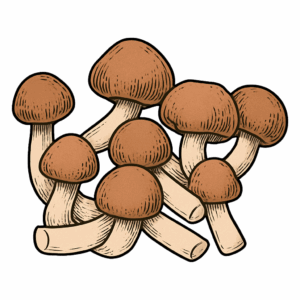
Agaricus blazei, sometimes called the “Mushroom of the Sun,” originated in Brazil and is now cultivated worldwide. It is included in supplements for its high content of beta-glucans, which are studied for their ability to help support balanced immune function. |

|
Shiitake mushrooms (Lentinula edodes) are edible fungi native to East Asia and widely cultivated around the world. Known for their rich flavor and dense nutritional profile, they contain polysaccharides such as lentinan along with antioxidants and micronutrients. In dogs, Shiitake mushrooms occasionally appear in functional food formulations and mushroom blends aimed at supporting immune balance, metabolic health, and overall resilience. |

Follow the Research
Studies providing deeper insight into Mushrooms
| Title | Information |
|---|---|
| Effects of increasing levels of purified beta-1,3/1,6-glucans on the fecal microbiome, digestibility, and immunity variables of healthy adult dogs | At a Glance A 2024 feeding trial in healthy adult dogs tested purified beta-1,3/1,6-glucans sourced from yeast. At a 0.14% inclusion in dry food, dogs showed improved protein digestibility, a microbiome shift toward generally beneficial bacteria, and a small uptick in an immune balance marker, with no adverse clinical effects noted. The authors frame beta-glucans as a family of fibers also found in fungi such as mushrooms, so these yeast results help inform the broader beta-glucan conversation. Connecting the Dots |
| Microbiota in mild inflammatory bowel disease (IBD) can be modulated by beta-glucans and mannanoligosaccharides: A randomized, double-blinded study in dogs | At a Glance This 2024 randomized, double-blinded clinical trial tested daily oral prebiotics in dogs with mild inflammatory bowel disease (IBD), a chronic intestinal condition where the immune system reacts abnormally to food and normal gut bacteria, disturbing the microbiota (“dysbiosis”). Over 60 days on a standardized hypoallergenic diet, beta-glucan supplementation improved bacterial diversity and supported groups often reduced in dysbiosis; adding mannanoligosaccharides (MOS) did not show clear extra benefit. Dogs stayed clinically stable and the products were well tolerated. Connecting the Dots |
| Shiitake mushroom powder supplementation increase antioxidative activity in dogs | At a Glance This 2024 study evaluated the effects of shiitake mushroom powder on cholesterol levels and antioxidant activity in healthy Beagle dogs. The authors reported a significant decrease in plasma cholesterol and significant increases in leukocyte sirtuin1 mRNA expression and plasma superoxide dismutase (SOD) activity after four weeks of supplementation. These findings suggest that shiitake powder may increase antioxidative activity and support metabolic regulation in dogs. Connecting the Dots |

Dig Deeper
Q/A's related to Mushrooms

Blog Articles
Articles related to Mushrooms
| Featured Image Link | Blog Title | Blog_URL_Link |
|---|---|---|
 |
The Truth About Mushrooms and Dogs: Natural Benefits vs. Hidden Risks | https://www.bernies.com/blogs/bernies-blog/the-truth-about-mushrooms-and-dogs-natural-benefits-vs-hidden-risks/ |