


That scene plays out at backyard cookouts across the country every summer, and most of the time, nothing happens. But cookout season also comes with a real uptick in the kinds of dietary mishaps that send dogs to the emergency vet, and it’s worth knowing why before the next holiday weekend [3].
Why Rich Cookout Food Is Hard on a Dog’s Digestion
Here’s the thing about a normal dog diet: it’s consistent. Same food, same fat content, same routine, day after day. A cookout throws that consistency out the window in one sitting. Burgers, sausage grease, buttered corn, chips, and dips are all rich, high-fat foods that a dog’s system isn’t used to processing in that volume.
That sudden shift can trigger vomiting, diarrhea, or a miserable few days, even in dogs with sturdy stomachs. And it’s not only about fat content. Researchers who study canine pancreatitis have found that dogs who get into unusual foods, the kind that show up at a cookout and nowhere else in their normal diet, face meaningfully higher odds of a digestive flare-up than dogs who stick to their regular meals [1]. It’s less about any single ingredient and more about the sudden, unpredictable nature of the whole event.
Which Cookout Foods Are Toxic to Dogs (and Which Are Okay)?
Some cookout staples cross the line from “not great for dogs” into outright dangerous.
Onions and garlic, whether raw, grilled, or baked into a burger patty, can damage a dog’s red blood cells and lead to anemia over time [2]. Xylitol, a sugar substitute, shows up more often than people expect in sugar-free condiments, some barbecue sauces, and certain baked desserts, and it can cause a dangerous drop in blood sugar [2]. Alcohol left in an unattended cup is another quiet risk [2]. And if there’s a fruit salad on the dessert table, keep grapes well out of paw’s reach [2].
None of this means the whole spread is off-limits, and giving dog parents that kind of practical, no-drama breakdown is what we’re all about at Bernie’s Best. A plain, unseasoned piece of grilled chicken or a few plain corn kernels are generally fine in small amounts. The riskier items tend to be the ones with seasoning, sauce, or a lot of fat mixed in.
Can Dogs Eat Corn on the Cob? Why Cobs and Skewers Are a Surgery Risk
Here’s a hazard that catches a lot of dog parents off guard: it’s not always what’s on the food that’s the problem. It’s what’s holding it together.
Corn cobs and kabob skewers are two of the more common causes of emergency surgery during grilling season [3]. A dog’s stomach can’t break down a corn cob, and once a piece moves into the small intestine, it often can’t pass on its own, creating a blockage that needs surgical removal [3]. Skewers carry their own risk since the sharp ends can puncture the esophagus, stomach, or intestinal wall on the way through [3]. We’ve covered general poison prevention steps before, and the same logic applies here: clear plates and cobs the moment the meal winds down.
Signs of an Upset Stomach vs. a Blockage in Dogs
Most cookout stomach trouble is mild and passes within a day or two. A few signs call for closer attention:
- One or two loose stools or a single episode of vomiting, especially right after the party, usually points to simple dietary upset
- Repeated vomiting, several rounds of diarrhea, or a dog who seems increasingly uncomfortable means it’s time to call your vet
- A hunched posture, a bloated-looking belly, or straining without producing stool can point to a possible blockage and needs same-day attention
- Loss of appetite lasting more than a day, alongside lethargy, calls for a vet visit rather than a wait-and-see approach
Can Table Scraps Trigger Pancreatitis in Dogs?
Occasionally, a rich cookout meal can trigger something more serious than a passing upset. Pancreatitis, an inflammation of the pancreas, is one possibility. Dietary indiscretion, the term for a dog eating something well outside their normal diet, is one of the more consistently identified risk factors [1]. High dietary fat by itself hasn’t been shown to reliably cause pancreatitis in controlled research. The clearer pattern researchers keep finding is the abrupt, unusual nature of what gets eaten, not the fat percentage on its own [4].
If your dog is showing more than mild signs, both conventional and supportive care have a role. Your vet may recommend bloodwork, IV fluids, or anti-nausea medication depending on severity, and pairing that with a bland recovery diet at home can help the gut settle once the acute phase has passed. If you want a deeper look at the condition itself, you can find the full clinical picture in our guide to pancreatitis in dogs.
Bland Diet for Dogs: What To Feed After a Cookout Stomach Upset
For the more common, garden-variety cookout stomach upset, a short bland diet can help settle things. Chicken and rice is the classic go-to, but it’s not the only option, and it’s not ideal for every dog. Turkey, eggs, or lean beef paired with plain pumpkin or sweet potato often works just as well, sometimes better, particularly for dogs who don’t love chicken. We walk through those options in more detail in our guide to feeding an upset stomach.
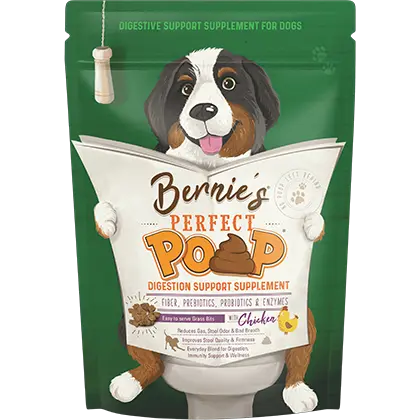
There’s a simple mechanical reason fiber, prebiotics, digestive enzymes, and probiotics show up together in gut health formulas. Start with fiber, which supports normal digestion and stool formation. Prebiotics are a type of fiber that feeds the good bacteria already in the gut. Digestive enzymes assist with breaking down fats and proteins. Probiotics contribute to a balanced population of gut bacteria. That’s the same combination found in Bernie’s Perfect Poop, with prebiotics added. It’s a complete 4-in-1 gut health formula built around Miscanthus grass fiber, prebiotics, spore-forming probiotics, and digestive enzymes. The fiber comes from three sources, with miscanthus grass as the main one and dried pumpkin and flaxseed alongside it. So if plain pumpkin is already part of your go-to bland diet, you’ll recognize one of the ingredients, just in a supporting role. Perfect Poop has been used by and has supported digestive wellness for millions of dogs, and many dog parents keep it in the daily rotation as one part of a broader approach to gut health, cookout season or not.
Should Your Dog Start a Digestive Supplement Before Summer?
There’s no single right way to time it. Some dog parents start a daily gut supplement like Perfect Poop well before the summer season kicks off, so their pup’s system already has steady support in place before the next holiday cookout arrives. Others reach for it more reactively, once a bad afternoon at a barbecue has already happened. Both approaches are reasonable. What matters more is consistency once you start, not which order you started in.
Perfect Poop mixes into any meal without the mess of a powder, which makes it an easy daily habit for dog parents who want ongoing gut support in place through a season full of grills, coolers, and unattended paper plates.
Give Your Dog’s Gut the Backup It Deserves This Summer
Cookout season doesn’t have to come with weeks of cleaning up after upset stomachs. Perfect Poop supports steady digestion, day in and day out, as one part of a daily wellness routine for dogs with sensitive stomachs. Every bag comes with our Growl-Free Guarantee, so if it’s not a fit for your dog, we’ll make it right.
Frequently Asked Questions
- Can dogs have hamburgers or hot dogs from the grill? A plain, small piece of fully cooked burger without seasoning, onion, or garlic is usually fine as an occasional bite. Hot dogs are higher in sodium and fat and are better left off the menu for dogs prone to stomach sensitivity.
- Is corn on the cob dangerous for dogs? The kernels themselves are generally safe in small amounts, but the cob is the real hazard. It’s indigestible and can lodge in the intestine, often requiring surgery to remove [3]. Skewers used for kabobs carry a similar risk and should be cleared from reach immediately.
- What should I do if my dog eats table scraps at a cookout? Watch for vomiting, diarrhea, or a change in energy over the next 24 to 48 hours. Mild, brief symptoms usually resolve on their own with a bland diet. Repeated vomiting, visible discomfort, or a swollen-looking belly warrants a same-day call to your vet.
- How can I tell if it’s just an upset stomach or something more serious? If it resolves within a day and your dog otherwise seems fine, it’s typically simple dietary upset. Anything that repeats, worsens, or comes with lethargy or a hunched posture is a signal to get it checked instead of waiting it out.
- Can I give my dog Perfect Poop before a cookout to help support their gut? Many dog parents keep a daily gut supplement like Perfect Poop in the rotation year-round, including through the summer months when rich foods and unattended plates are more common. Starting it ahead of the season is one reasonable approach, though there’s no single right time to begin.
References
- Lem KY, Fosgate GT, Norby B, Steiner JM. Associations between dietary factors and pancreatitis in dogs. J Am Vet Med Assoc. 2008;233(9):1425-1431. https://doi.org/10.2460/javma.233.9.1425
- Cortinovis C, Caloni F. Household Food Items Toxic to Dogs and Cats. Front Vet Sci. 2016;3:26. https://doi.org/10.3389/fvets.2016.00026
- Pavletic MM. Safeguard Your Pet from BBQ Hazards. MSPCA-Angell. Published April 18, 2026. https://www.mspca.org/advocacy-issues/safeguard-your-pet-from-bbq-hazards/
- Yamka R, Sires R, Wakshlag J, Gaylord L, Cridge H. High fat, high risk? Evaluating the strength of evidence linking dietary fat and pancreatitis in dogs. J Am Vet Med Assoc. 2026 Feb 18:1-7. https://doi.org/10.2460/javma.25.11.0773


