



Here’s the good news first: in most cases, this is simple biology, not a crisis. But not always. And knowing the difference matters.
Why Salt Water Doesn’t Sit Well With Your Dog’s Gut
Seawater contains roughly 3.5 percent sodium [1], which is a lot more than your dog’s digestive system is built to process in one sitting. When that much salt lands in the intestines, it pulls water across the intestinal wall and into the gut, rather than letting it get absorbed the way water normally would. That’s the mechanism behind what’s called osmotic diarrhea [3], and it’s the same basic process that makes certain sugar substitutes upset human stomachs.
The salt acts as the trigger. The intestinal lining responds by drawing in water to try to balance things out. The result is loose, watery stool, sometimes within a few hours of your dog lapping up that big gulp.
Here’s the tricky part: a small amount of saltwater usually isn’t a problem. Dogs’ kidneys and hydration systems can handle occasional exposure just fine, especially if fresh water is available nearby. The issue is volume. A dog who’s really going for it, drinking repeatedly while playing, is taking in a different amount of sodium than one who just gets an accidental mouthful while fetching a ball, and that’s the kind of nuance we try to spell out clearly at Bernie’s Best.
Salt Water Poisoning in Dogs: When It’s More Than Diarrhea
Most beach-day diarrhea is mild and short-lived, and it typically settles on its own within a day. That’s worth saying clearly, so you’re not spending the evening panicking over a single loose stool.
But saltwater ingestion has a more serious ceiling too. When a dog takes in a large amount of saltwater, sodium levels in the blood can climb high enough to cause a condition called salt toxicosis, sometimes described as hypernatremia [1]. This isn’t the same thing as ordinary tummy upset. It’s a real veterinary emergency, and dogs have developed it from swimming or playing hard in the ocean without access to fresh water [1].
Signs that go beyond routine diarrhea and warrant an immediate call to your vet or an emergency animal hospital include:
- Repeated vomiting alongside the diarrhea
- Wobbliness, disorientation, or unusual weakness
- Muscle tremors or twitching
- Seizures
- Extreme lethargy or a dog who seems “off” in a way that doesn’t match a simple stomach upset
These symptoms have been reported within about three hours of a large ingestion [2]. If you see any of them, this isn’t a wait-and-see situation. Get your dog to a vet.
What Helps a Dog With Diarrhea After a Beach Day
For the mild, more common version of this, the goal is letting your dog’s gut settle back down while making sure dehydration doesn’t sneak in behind the diarrhea. Fresh water should be available at all times, both during the beach trip and afterward. Some dog parents assume a dog with diarrhea should be kept away from water, but the opposite is usually true here. It’s the salt load that caused the problem to begin with, and fresh water helps the body rebalance.
If your dog’s appetite is still normal and there’s no vomiting or concerning symptoms, a short period of easily digestible food can help. Chicken and rice gets recommended constantly for this, but it’s not the only option, and it isn’t ideal for every dog. Turkey, eggs, or lean beef paired with plain pumpkin or sweet potato covers similar ground while adding fiber that chicken and rice typically lack. Your vet can help you figure out what makes sense if the diarrhea sticks around longer than a day or two, or if your dog has other health considerations.
Keeping Your Dog’s Gut Steady Between Beach Trips
Dogs who spend a lot of time near saltwater, whether it’s weekly beach walks or a summer of lake and ocean visits, tend to have more of these occasional gut disruptions than dogs who don’t. That’s not really an ocean problem. It’s more of a “how resilient is the gut day to day” problem, and diet plays a role in that resilience.
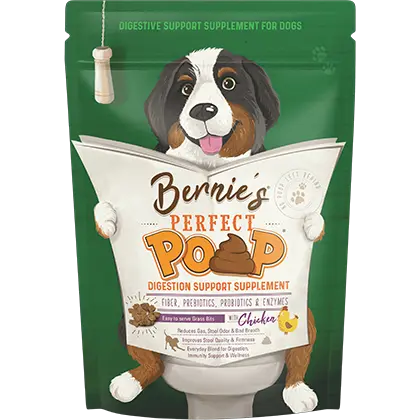
This is where adding a daily digestive supplement to the routine can make sense, not as a fix for an active toxicosis case, but as ongoing support for a gut that gets challenged more often than most. Miscanthus grass fiber, prebiotics, probiotics, and digestive enzymes come together in one daily formula with Bernie’s Perfect Poop, supporting stool quality and general digestive balance over time. The fiber comes from three sources: Miscanthus grass as the main one, with dried pumpkin and flaxseed alongside it. So if plain pumpkin is already part of your post-beach routine, you’ll recognize one of the ingredients. For dogs whose beach habit means their gut gets tested more than the average dog’s, that kind of baseline support may help contribute to more consistent stool quality, even after an off day. The label suggests introducing it gradually over about a week. If your dog’s stool has been inconsistent beyond the occasional beach-day episode, that’s worth a conversation with your vet.
Making Beach Days Safer for Dogs
A few habits go a long way toward keeping saltwater exposure in the harmless range. Bring fresh water and a bowl, and offer it regularly, especially during active play in the surf. Watch for dogs who seem to be drinking rather than just splashing, since some dogs treat wave-chasing as an excuse to gulp [4]. Take water breaks the same way you’d take them yourself on a hot day.
Saltwater isn’t the only beach hazard to plan for, and the signs and response steps for other emergencies are covered in this guide on recognizing and responding to poisoning emergencies.
For deeper background on diarrhea in dogs generally, including causes unrelated to the beach, more can be found in Bernie’s University page on diarrhea.
One Loose Stool Isn’t a Crisis for Your Dog. These Signs Are.
A little saltwater usually means a messy afternoon and a loose stool or two. That’s the biology working the way it’s supposed to. What matters is paying attention to the difference between “my dog had one loose stool” and “my dog is disoriented and trembling.” One of those calls for fresh water and a bland dinner. The other calls for a vet, immediately.
Give Your Dog’s Gut Some Backup
Bernie’s Perfect Poop combines fiber, prebiotics, probiotics, and digestive enzymes in one daily serving, built to support stool quality and digestive resilience for dogs whose gut gets tested more than most, beach trips included. Every bag is backed by our Growl-Free Guarantee, so trying it out is risk-free.
Frequently Asked Questions
- Is it normal for dogs to get diarrhea after playing in the ocean? Yes, and it’s fairly common. Seawater’s high salt content pulls water into the intestines, which can cause loose stool within a few hours of a dog swallowing a meaningful amount. Most cases are mild and resolve within a day once the salt works its way through the system.
- How much saltwater is dangerous for a dog? It depends on your dog’s size and how much fresh water they’ve had access to. Toxic effects have been associated with sodium intake in the range of 2 to 3 grams per kilogram of body weight, with higher amounts becoming potentially fatal [2]. A dog actively gulping ocean water during play is at more risk than one who takes an occasional accidental mouthful.
- What are the warning signs of salt poisoning in dogs? Beyond diarrhea, watch for repeated vomiting, wobbliness or disorientation, muscle tremors, seizures, or extreme lethargy. These can appear within a few hours of a large ingestion. Any of these symptoms call for immediate veterinary care, not a wait-and-see approach.
- Should I withhold water if my dog has diarrhea from the beach? No. Fresh water is part of the solution here, since it helps rebalance the sodium load that caused the problem. Keep water available and encourage your dog to drink normally unless your vet advises otherwise for a specific reason.
- What should I feed my dog after a bout of beach-related diarrhea? If your dog’s appetite and energy seem otherwise normal, a short stretch of bland, easily digestible food can help. Turkey, eggs, or lean beef paired with plain pumpkin or sweet potato works well and adds fiber that a chicken-and-rice combo typically lacks. If diarrhea continues past a day or two, check in with your vet.
References
- Merck Veterinary Manual. Salt Toxicosis in Animals. Merck & Co., Inc. 2024. https://www.merckvetmanual.com/toxicology/salt-toxicosis/salt-toxicosis-in-animals
- American College of Veterinary Pharmacists. Pet Poison Control List: Salt. Citing Osweiler G, et al. Blackwell’s Five-Minute Veterinary Consult Clinical Companion: Small Animal Toxicology, 2011. ACVP, 2023. https://vetmeds.org/pet-poison-control-list/salt/
- Armstrong PJ. GI Intervention: Approach to Diagnosis and Therapy of the Patient With Acute Diarrhea. Today’s Veterinary Practice. 2013. https://todaysveterinarypractice.com/gastroenterology/gi-intervention-approach-to-diagnosis-and-therapy-of-the-patient-with-acute-diarrhea/
- Burke A. Is It Dangerous for Dogs to Drink Salt Water? What You Need to Know About Saltwater Poisoning. American Kennel Club. Updated 2024. https://www.akc.org/expert-advice/health/dogs-drinking-salt-water/


