

So if you’ve ever flipped over a bag of your dog’s probiotic supplement and wondered why a fiber like inulin is sitting next to probiotic strain names like Bacillus subtilis or Bacillus coagulans, there’s a good reason.
Inulin helps feed beneficial gut bacteria, including bacteria already living in your dog’s digestive tract. That’s why it often shows up alongside probiotics. One adds beneficial microorganisms, while the other helps support the microbial community they’re joining.
And that combination matters more than simply packing a supplement with more probiotic strains.
Probiotics Need Something to Eat
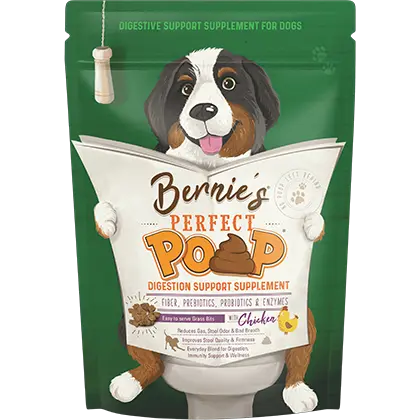
As the makers of a probiotic supplement, we think a lot about what happens to those probiotics after your dog eats them. Bacillus subtilis and Bacillus coagulans, the two strains in Bernie’s Perfect Poop, are living organisms. They have to survive the trip through your dog’s stomach acid, reach the gut and then actually do something once they’re there. That means a good probiotic formula isn’t just about adding more bacteria to the label. It’s also about supporting the environment those bacteria are entering.
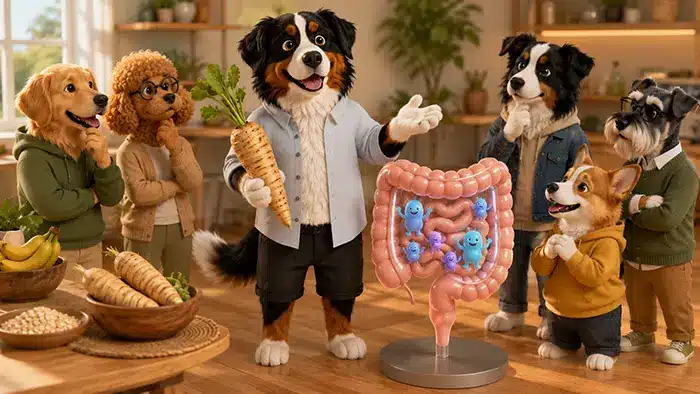
Inulin is food for the beneficial bacteria already living in your dog’s gut, along with the ones arriving via supplement. It’s a type of soluble fiber that dogs can’t digest on their own, since they lack the enzymes to break it down in the stomach or small intestine.[1] Instead, it travels intact to the colon, where resident bacteria ferment it.
That’s what makes inulin a prebiotic rather than a probiotic. Probiotics provide live microorganisms, while prebiotics provide food that certain microorganisms can use.
That fermentation is the whole point. As gut bacteria break down inulin, they produce short-chain fatty acids, compounds like butyrate, acetate, and propionate, that may help nourish the cells lining the colon and support a healthier gut lining overall, which ties directly into the gut-immune connection that shapes so much of a dog’s overall wellness. [1][4]
A dog’s gut isn’t just where digestion happens. It’s also where a large share of the immune system lives,[6] which is why feeding the right bacteria has effects that reach well beyond stool quality.
This Combination Has a Name: Synbiotics
Pairing a prebiotic fiber with live probiotic bacteria isn’t a random formulation choice. It’s a recognized category called a synbiotic, and the distinction actually matters.
According to the International Scientific Association for Probiotics and Prebiotics, a synbiotic is formally defined as a mixture of live microorganisms and a substrate that’s selectively used by those microorganisms to confer a health benefit.[2] When a formula combines that kind of fiber with live probiotic strains, the goal is for the two to work as a team rather than as two separate ingredients competing for label space.
Some synbiotics are what researchers call “complementary,” meaning the fiber and the bacteria each work independently. Others are “synergistic,” where the fiber is specifically chosen because it feeds the exact bacteria included in the formula.[2] Perfect Poop’s inulin and XOS combination leans toward this second category, since both prebiotics are commonly paired with Bacillus-based probiotics in synbiotic formulas.
Without the fiber, probiotic bacteria still arrive in the gut, but they’re working with less fuel to establish themselves and multiply. Skip the prebiotic and you’re essentially sending in reinforcements without supplies. It’s the kind of thinking that runs through every Bernie’s Best formula, pairing ingredients so they actually support each other instead of just sitting next to each other on a label.
What This Looks Like in a Dog’s Gut
Most of the inulin research in dogs comes from studies on fiber supplementation and weight management, and the findings back up the mechanism. In one study on overweight dogs, inulin-type fructans measurably increased fecal short-chain fatty acid concentrations and shifted the gut microbiota toward a higher proportion of beneficial bacteria.[3] A separate in vitro model using fecal samples from dogs of different sizes found that inulin consistently increased acetate and propionate production across small, medium, and large dogs,[4] suggesting the effect holds up regardless of a dog’s size or breed.
That doesn’t mean inulin single-handedly resolves digestive issues. It means it’s doing a specific, supporting job of feeding the bacteria that are doing the heavier lifting, and how inulin works really comes down to that one targeted role rather than any broader claim.
A Little Goes a Long Way
More fiber isn’t automatically better, either. Inulin doses in most supplements, including Perfect Poop’s 20mg per tablespoon, are modest by design. Large amounts of fermentable fiber introduced too quickly can cause gas or loose stool as the gut microbiota adjusts, which is part of why gradual introduction matters with any new fiber source, supplement or otherwise. Most formulas balance inulin with other prebiotics like XOS to spread the fermentation load rather than relying on one fiber source to do everything.
For dog parents who want the fuller research picture on how inulin interacts with different gut bacteria and dosing, the difference between prebiotics and probiotics is covered in more depth at Bernie’s University.
Why Inulin Belongs in a Probiotic Formula
Inulin is there for a reason. A probiotic supplement is not just about adding live bacteria. It is also about supporting the gut environment those bacteria are entering.
That is why prebiotics like inulin can be such a useful part of the formula. They provide fermentable fiber that certain beneficial gut bacteria can use, helping support the broader microbial activity probiotics are meant to complement.
For us, that is the bigger point. Good gut support is rarely about one ingredient doing everything. It is about combining ingredients that play different roles and work together to support digestion, microbial balance and overall gut health.
Give Your Dog’s Gut the Full Toolkit
Bernie’s Perfect Poop has been used by and has supported digestive wellness for millions of dogs, pairing inulin and XOS with two hardy Bacillus probiotic strains and a blend of digestive enzymes in one convenient daily scoop. Every bag comes with our Growl-Free Guarantee, so if your dog’s gut doesn’t seem to notice the difference, we’ll make it right.
Frequently Asked Questions
Is inulin the same as fiber? Inulin is a type of fiber, specifically a soluble, fermentable fiber that dogs can’t break down with their own digestive enzymes. It passes to the colon where gut bacteria ferment it, which sets it apart from insoluble fibers that mainly add bulk to stool.
Can inulin cause gas in dogs? It can, particularly if introduced too quickly or in large amounts. Fermentation naturally produces some gas as a byproduct. Starting with a smaller amount and building up gradually usually helps a dog’s system adjust.
Do probiotics work without a prebiotic like inulin? Probiotic bacteria can still provide some benefit on their own, but without an accompanying fiber source, they tend to have less fuel to establish themselves and multiply in the gut, which may limit how effective they are.
Where does inulin come from? Inulin occurs naturally in a number of plants and is most commonly extracted from chicory root for supplement and food use.[5]
Is inulin safe for all dogs? Inulin is generally well tolerated in appropriate amounts. Dogs with sensitive digestive systems may benefit from a slower introduction. As with any new supplement, check with your vet if your dog has an existing digestive condition.
References
[1] Gibson GR, Hutkins R, Sanders ME, Prescott SL, Reimer RA, Salminen SJ, Scott K, Stanton C, Swanson KS, Cani PD, Verbeke K, Reid G. Expert consensus document: The International Scientific Association for Probiotics and Prebiotics (ISAPP) consensus statement on the definition and scope of prebiotics. Nature Reviews Gastroenterology & Hepatology. 2017;14(8):491-502. https://doi.org/10.1038/nrgastro.2017.75
[2] Swanson KS, Gibson GR, Hutkins R, Reimer RA, Reid G, Verbeke K, Scott KP, Holscher HD, Azad MB, Delzenne NM, Sanders ME. The International Scientific Association for Probiotics and Prebiotics (ISAPP) consensus statement on the definition and scope of synbiotics. Nature Reviews Gastroenterology & Hepatology. 2020;17(11):687-701. https://doi.org/10.1038/s41575-020-0344-2
[3] Alexander C, Cross TW, Devendran S, Neumer F, Theis S, Ridlon JM, Suchodolski JS, de Godoy MRC, Swanson KS. Effects of prebiotic inulin-type fructans on blood metabolite and hormone concentrations and faecal microbiota and metabolites in overweight dogs. British Journal of Nutrition. 2018;120(6):711-720. https://doi.org/10.1017/S0007114518001952
[4] McKay S, Churchill H, Hayward MR, Klein BA, Van Meulebroek L, Ghyselinck J, Marzorati M. Effects of cRG-I prebiotic treatment on gut microbiota composition and metabolic activity in dogs in vitro. Microorganisms. 2025;13(8):1825. https://doi.org/10.3390/microorganisms13081825
[5] Canazza E, Grauso M, Mihaylova D, Lante A. Techno-Functional Properties and Applications of Inulin in Food Systems. Gels. 2025;11(10):829. https://doi.org/10.3390/gels11100829
[6] Ruth MR, Field CJ. The immune modifying effects of amino acids on gut-associated lymphoid tissue. Journal of Animal Science and Biotechnology. 2013;4(1):27. https://doi.org/10.1186/2049-1891-4-27