



Or maybe it’s not that dramatic. Maybe they still go, but the walk feels different now. Shorter. Slower. They stop to sniff things they used to blow right past, and not in the fun, curious way. More like they’re looking for a reason to pause.
Either version is worth paying attention to. A dog who suddenly seems less into walks isn’t being dramatic or difficult. Something changed, and figuring out what usually starts with ruling out the simple stuff before moving on to anything more serious.
Before You Worry, Consider the Obvious
At Bernie’s Best, we don’t treat every dip in enthusiasm as a health issue. Dogs have off days the same way people do, and a few common, harmless explanations are worth ruling out before anything else.
Weather is a big one. Heat and humidity can make a walk feel like a chore fast, especially for dogs with thick coats or short muzzles, and cold, wet pavement isn’t exactly appealing either. If the reluctance lines up with a heat wave or a cold snap, that’s probably your answer.
The same route, walked the same way, at the same time, every single day, can also lose its charm. Dogs get bored just like people do. A new direction around the block or a different park is sometimes all it takes to flip the switch back on.
Sore muscles are worth considering too, especially after a longer hike, an extra-rowdy play session at the dog park, or a hot afternoon spent chasing squirrels. A day or two of stiffness afterward is normal, and it usually resolves on its own without any intervention.
When It’s Something in the Joints
If the reluctance sticks around longer than a few days, or if it’s part of a pattern rather than a one-off, joint discomfort becomes the more likely explanation. And it’s worth knowing that reluctance to exercise is one of the specific behavioral signs veterinarians look for when assessing pain in dogs [1][2], right alongside stiffness, slower movement, and hesitation before jumping or climbing stairs.
Here’s the part that surprises a lot of dog parents: this isn’t only an old-dog problem. In one study, researchers screened dogs between eight months and four years old, an age range most people would call young, and found radiographic signs of osteoarthritis in nearly 40 percent of them [3]. Many of those dogs weren’t limping or obviously struggling. The joint changes were already there before anything visible showed up on a walk.
That gap between what’s happening inside a joint and what’s visible on the outside is exactly why a change like “doesn’t want to walk as much anymore” matters. It’s often the more obvious signal, the kind that shows up once joint changes have already been building quietly underneath.
Mechanically, here’s what’s going on. Cartilage cushions the ends of bones and lets a joint glide smoothly. When that cartilage starts to wear down, whether from age, activity level, weight, or breed-related joint structure, bone can begin making more direct contact during movement [6]. That triggers inflammation. Inflammation brings stiffness. Stiffness makes a dog hesitate before doing the things that used to be effortless, including walking.
What Actually Helps
Both conventional and holistic approaches have a role here, and they’re not in competition with each other.
A vet visit is the right starting point for anything beyond a passing off day, since a physical exam can rule out injury and confirm whether joint changes are actually driving the behavior. From there, options range from prescription anti-inflammatories for more advanced cases to weight management, low-impact exercise adjustments, and targeted nutritional support, often used together rather than picked as one-or-the-other.
On the nutritional side, research on marine omega-3s is worth knowing about. Studies on EPA and DHA supplementation have looked at reported comfort levels in dogs, with some showing improvement, particularly in smaller dogs [5]. That research is about the ingredient category broadly, not a specific outcome tied to any one product or dose. It’s one piece of a broader pattern researchers have been tracking around anti-inflammatory nutrients and joint comfort. ngredients like turmeric extract, boswellia, and undenatured Type II collagen work through different mechanisms, curcumin supporting a normal inflammatory response, boswellia also supporting a normal inflammatory response in the joint, and collagen helping maintain the connective tissue that makes up cartilage. We go deeper on how that compound works in our university page on undenatured Type II collagen.
This is also where the prevention-first piece matters. Joint support doesn’t have to wait until a dog is already slowing down on walks. Large and giant breeds, dogs with a family history of hip or elbow issues, and highly active dogs are all reasonable candidates for starting support earlier, before any signs show up.
When to Call the Vet Instead of Waiting It Out
Not every case of reduced walk enthusiasm comes down to joints. Decreased stamina gets misread as simple aging fairly often, when the actual cause can be something like hypothyroidism or early heart disease [4], both of which a vet can screen for with straightforward testing.
A few patterns are worth a call rather than a wait-and-see approach: limping or favoring a leg, labored breathing that isn’t tied to heat or exertion, a sudden and total refusal to move at all, or reluctance paired with changes in appetite, thirst, or energy at home. None of these are cause for panic. They’re simply signs that a vet exam, rather than a guess, is the next right step.
Bernie’s Marvelous Mobility: Built for Days Like This
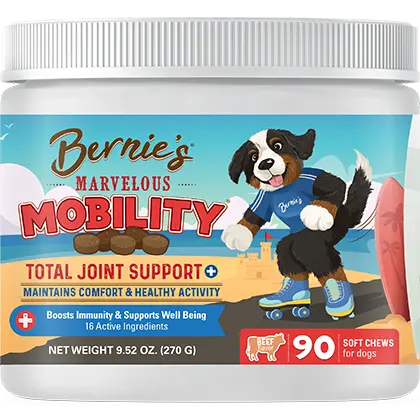
Once joint discomfort is part of the picture, nutrition becomes one of the more practical daily tools available. Bernie’s Marvelous Mobility was formulated around 16 active ingredients chosen for how they work together, rather than leaning on glucosamine and chondroitin, ingredients research increasingly suggests fall short at typical oral supplement doses.
Instead, the formula includes undenatured Type II collagen, omega-3s from algal and anchovy oil, turmeric extract, boswellia, and astaxanthin, along with supporting vitamins and minerals like boron and vitamin K2. Rather than focusing on joints alone, the blend is designed to help support connective tissue, a normal inflammatory response, and whole-body vitality. Soft chews come in a smoky, savory flavor most dogs treat like an actual treat, with serving size scaled to your dog’s weight.
We built Marvelous Mobility to help support the joint comfort that can make walks feel exciting again, not just something to tolerate.tt
If you want a clearer sense of what early joint changes tend to look like day to day, we go over the signs vets watch for in our guide to spotting early joint issues. And for the deeper science behind what’s actually happening at the joint level, we go into more detail in our university page on osteoarthritis.
Give Your Dog a Reason to Grab the Leash Again
A sudden change in how excited your dog is about walks is worth listening to, whether it turns out to be nothing more than a hot afternoon or something your vet needs to weigh in on. If joint comfort turns out to be part of the story, Marvelous Mobility is built to support your dog’s mobility every day, backed by our Growl-Free Guarantee. If it’s not the right fit, we’ll make it right for you and your dog, no hassle. That’s the kind of thing dog parents can count on.
Frequently Asked Questions
Why does my dog suddenly not want to go on walks? A sudden drop in walk enthusiasm can come from something as simple as hot weather, a sore muscle from an active weekend, or boredom with the same route. It can also point to joint discomfort, especially if the reluctance sticks around for more than a few days. Watching for other signs, like stiffness after resting or hesitation on stairs, can help narrow it down.
Is it normal for older dogs to slow down on walks? Some slowing with age is expected, but a sudden or significant drop shouldn’t be written off as “just getting older” without a closer look. Conditions like joint discomfort, thyroid changes, and early heart issues can all look like normal aging on the surface, and a vet visit can help sort out which one is actually happening.
Can weather really affect how much my dog wants to walk? Yes. Heat and humidity make exercise feel harder for dogs, particularly those with thick double coats or short muzzles, and cold, wet conditions can be just as unappealing. If the timing lines up with a weather shift, that’s often the simplest explanation.
How can I tell if my dog’s reluctance to walk is from joint pain? Look for patterns beyond the walk itself. Stiffness after lying down, hesitation before jumping onto furniture, slower movement right after waking up, and reluctance to use stairs often show up alongside reduced interest in exercise when joints are the underlying cause. A vet exam is the most reliable way to confirm it.
Does my dog need to already be showing symptoms before starting a joint supplement? No. Joint support doesn’t have to wait for visible signs. Large breeds, dogs with a family history of joint issues, and highly active dogs may benefit from starting support earlier, since joint changes can be underway well before a dog shows any outward difference in behavior.
References
- Cornell University Riney Canine Health Center. “Recognizing Pain in Dogs.” Cornell University College of Veterinary Medicine. Accessed 2026. https://www.vet.cornell.edu/departments-centers-and-institutes/riney-canine-health-center/canine-health-topics/recognizing-pain-dogs
- American Animal Hospital Association. “What’s Wrong? Common Pet Pain Signs.” AAHA. 2024. https://www.aaha.org/resources/whats-wrong-common-pet-pain-signs/
- Enomoto M, de Castro N, Hash J, et al. “Prevalence of radiographic appendicular osteoarthritis and associated clinical signs in young dogs.” Scientific Reports. 2024;14:2827. https://doi.org/10.1038/s41598-024-52324-9
- VCA Animal Hospitals. “How to Recognize Pain in Aging Dogs.” Accessed 2026. https://vcahospitals.com/know-your-pet/behavior-changes-and-pain-in-aging-dogs
- Carlisle C, Metzger BT, Tintle NL, Polley K, Jackson KH, Le Brun-Blashka S, Griffiths J, Harris WS. “The Effects of Omega-3 Supplementation on the Omega-3 Index and Quality of Life and Pain Scores in Dogs.” Animals. 2024;14(21):3108. https://doi.org/10.3390/ani14213108
- Cornell University Riney Canine Health Center. “Osteoarthritis.” Cornell University College of Veterinary Medicine. Accessed 2026. https://www.vet.cornell.edu/departments-centers-and-institutes/riney-canine-health-center/canine-health-topics/osteoarthritis


