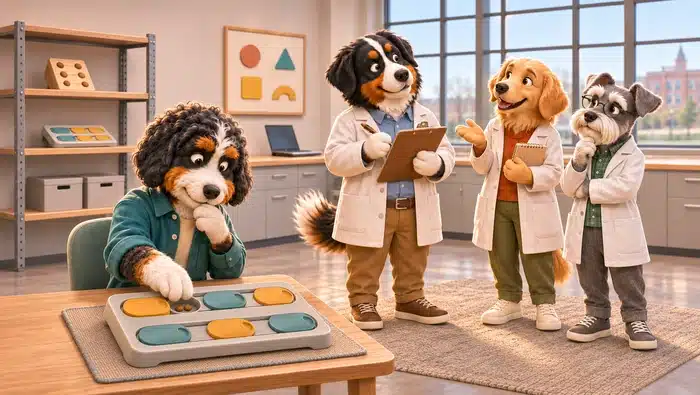


When we heard the team was looking for participants, we wanted to help spread the word. At Bernie’s, we’re always looking for opportunities to learn more about dogs and help them live their happiest, healthiest lives. This brings together several things we’re excited about: canine research, meaningful mental enrichment, and families getting involved in the discoveries.
As of November 2026, the program is accepting registrations for current and future studies. These opportunities involve in-person lab visits at Johns Hopkins in Baltimore, Maryland. The invitation described here is for families who can travel to the lab; it does not advertise a virtual participation option yet.
If that’s within reach, your dog could become part of the research. And wherever you live, there’s something here for anyone who has ever wondered what’s going on behind their dog’s curious expression. Understanding the questions researchers ask can inspire us to notice more about our own dogs: how they approach a puzzle, what catches their attention, and which activities they choose to return to. Below, we’ll share ways to explore that curiosity together, with resources for games and enrichment you can try at home.
We’re also keeping an eye out for more opportunities for dog families to get involved in research. If this one is too far away or isn’t the right fit for your dog, stay tuned. We’ll keep sharing interesting projects as we find them, including ways to participate from home when those opportunities come up.
What Is the Canine Minds Collaborative?
The Canine Minds Collaborative brings researchers and local pet families together to study dog thinking and behavior. Scientists often call this field “canine cognition.” In everyday language, it means investigating how dogs take in information, remember things, make decisions, and solve problems.
Dogs visit the lab with their people and take part in games and puzzles. Researchers observe their choices and responses to investigate abilities such as memory, attention, and social behavior. Pet parents either participate directly or watch their dog through a live video feed from the next room. That video feed is part of the in-person visit.
The lab describes its research as non-invasive, with dogs choosing whether to participate. Its research is approved by Johns Hopkins University’s Animal Care and Use Committee.
For families who enjoy discovering what makes their dog tick, it’s a chance to share that curiosity with people who study these questions professionally.
How Can Your Dog Get Involved?
The university’s October recruitment announcement invites dogs over one year old, of all breeds and sizes.
Getting started means completing a short registration form, rather than committing to a study right away. The form takes approximately 5–10 minutes. Have your dog’s most recent rabies and DHPP vaccination dates handy, and complete a separate registration for each dog.
The research team uses that information to help match dogs with suitable studies. Registering doesn’t guarantee a place or obligate your family to participate, and invitations may take several weeks.
Register Your Dog for Johns Hopkins Study Invitations
If you’re wondering whether the setting or activities would suit your dog, contact the team at dogs@jhu.edu.
Can’t make the trip? Sharing the official invitation with someone near Baltimore is another useful way to help.
A Chance to Become a Citizen Scientist
“Citizen science” means members of the public helping with scientific research. Here, families make the work possible by bringing their dogs to participate.
You already know your dog’s favorite games, familiar routines, and wonderfully particular preferences. Researchers bring structured methods for investigating questions across many dogs. Together, those contributions help scientists explore patterns they couldn’t establish from watching one dog alone.
It’s a cool possibility: an outing with your dog could contribute to what we understand about canine minds. You don’t need a science degree to help. You need an interest in the research and a dog who is a suitable, willing participant.
What Can Dog Cognition Research Teach Us About Our Own Dogs?
Have you watched your dog try a different approach to reaching a toy, search a spot twice, or turn toward you when a puzzle gets tricky? Those moments can make you wonder what information they’re using and what they’ll try next.
Researchers investigate questions like these under structured conditions. At home, paying closer attention can help us understand what our individual dogs enjoy and how they engage with the world.
That fits naturally into Bernie’s approach to mental wellness. Caring for dogs includes opportunities to investigate, make choices, and use their abilities in satisfying ways. Noticing how they respond helps us choose experiences that suit them.
A dog who eagerly returns for another search is giving us different information from one who walks away. We can respond by offering another turn, making something easier, trying a different activity, or leaving room for rest.
Can You Explore Your Dog’s Cognition Without Joining a Study?
Absolutely. You can start with a simple search or food puzzle and enjoy watching how your dog approaches it. There’s no need to score their performance. Familiarity, motivation, surroundings, and how they feel that day can all influence their response.
We’ve put together several resources to help you find an activity your dog might enjoy:
Let Your Dog’s Nose Lead the Way
An easy “find it” game gives your dog something interesting to investigate. Start with food in accessible spots, then watch how they search as they become familiar with the game. Our guide introduces beginner activities you can try together.
Try These Beginner Scent Games at Home
Discover How Your Dog Tackles a Food Puzzle
Does your dog investigate with their nose, try a paw, or switch between the two? An appropriately chosen puzzle feeder or supervised snuffle mat offers a chance to observe their approach. Explore the differences and find a starting point that suits your dog.
Explore Snuffle Mats and Puzzle Feeders
Find What Makes Enrichment Meaningful for Your Dog
The best fit depends on the individual. Bernie’s University explores how activities can give dogs opportunities to use their senses, solve problems, and express natural behaviors. Our Mind-Body Wellness philosophy connects those opportunities with the wider picture of a fulfilling life.
Explore Mental Enrichment at Bernie’s University
Read Our Mind-Body Wellness Philosophy
Keep activities manageable and give your dog room to disengage. If you’re wondering how to balance engagement with downtime, we explore that question here:
Can Dogs Have Too Much Enrichment?
These are home enrichment ideas, separate from Johns Hopkins’ research procedures. They offer ways to spend time together and learn about your dog’s interests.
Helping Researchers Learn More About Dogs
We’re excited to share opportunities that bring dog families closer to the science. Research depends on participation, and helping the right people hear about a project is one small way we can support new discoveries.
If an in-person visit to Johns Hopkins sounds like something your family and dog might enjoy, take a look at the registration form. If someone you know could be a good fit, send them the invitation.
Learn About Participating in the Canine Minds Collaborative
More Ways to Keep Learning and Get Involved
You don’t have to live near Baltimore to share our excitement about learning more about dogs. Alongside our interest in the Dog Aging Project, we’re keeping an eye out for other research efforts that dog families can follow, contribute to, or help spread the word about.
We recently shared the work of Berner-Garde, another example of how families can contribute to canine health research. Its database brings together health and pedigree information about Bernese Mountain Dogs, helping researchers investigate questions about disease, genetics, and longevity. That work is especially close to our hearts because of Bernie, the Berner who inspired our company.
Discover Berner-Garde and How Dog Families Can Help
As we build out our dog breed articles at Bernie’s University, we’re also looking for breed-specific projects and opportunities worth sharing. Our Doberman page, for example, explores how documented family longevity and breed health information can help people ask better questions about their dogs. We want these resources to help families understand their breed while discovering the people and projects working to improve its future.
Explore Doberman Health, Longevity, and Breed Resources
Check Out Other Bernie’s University Breed Posts (new breeds added weekly)
That’s why Bernie’s cares about connecting our community with this work. We want more healthy, happy time with our dogs, and we want to understand what can help make that possible. Our interest in lifespan and healthspan brings those hopes together with the questions researchers are exploring.
More Time With Our Dogs: A Look at Lifespan and Healthspan
If the Johns Hopkins opportunity isn’t a fit for your family, subscribe to keep reading and learning with us. We’ll keep looking for worthwhile projects to share, including breed-specific research and opportunities to contribute from home when available. There are many ways to be part of learning more about dogs, and we’re excited to help our community find them.