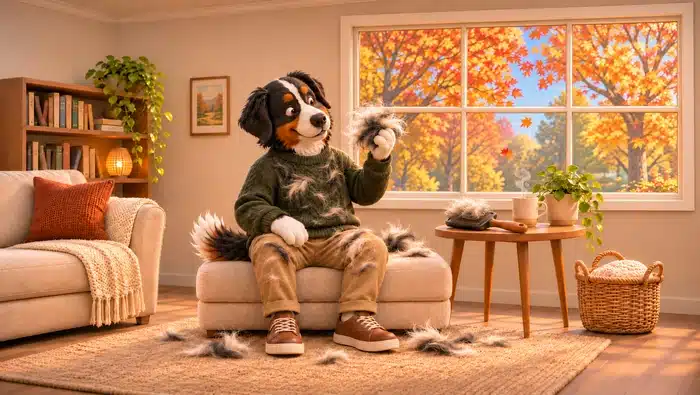




Changes in daylight and temperature help trigger that process, though the timing and amount of shedding depend on your dog’s coat and environment. Let’s look at why it happens, what normal fall shedding looks like, and how you can support healthy skin and coat along the way.
Why Dogs Shed Their Summer Coat Before Winter
Every hair on your dog’s body runs through the same basic cycle. During the growing phase, the hair follicle (the small pocket in the skin each hair grows from) keeps making hair. Once a hair reaches its preset length, it stops growing and rests in the follicle as a dead hair. It stays put until a new hair starts growing underneath and pushes the old one out [2].
That push is the shedding you’re seeing, and it’s a routine part of skin and coat health in dogs. In a normal shed, the hair on your floor is being replaced from below. Dogs swap out hair in a patchwork pattern all year long, with peaks in spring and fall [2]. Fall is simply one of the busy seasons.
What a Dog’s Undercoat Does in Cold Weather
Here’s the part that clears up the cold-weather puzzle. A dog’s hair follicles are compound, which means one central hair shares a pore with 3 to 15 smaller secondary hairs [1]. In double-coated dogs, those shorter, softer hairs make up a dense undercoat beneath the coarser topcoat, and that undercoat traps warmth close to the body during the colder months [3].
Many dogs also grow a cold-weather coat with longer, finer hair that holds in more heat. A summer coat works the other way, with shorter, thicker hairs and fewer secondary hairs, so air can move through and help cool the skin [1].
So a dog heading into winter isn’t trying to keep their summer coat. That coat was built for a different job. Shedding it is how the winter version gets room to come in.
What Triggers Fall Shedding in Dogs?
A dog’s coat doesn’t check the thermostat. The hair cycle takes its cues mostly from day length and outdoor temperature, along with health, genetics, nutrition, and hormones [2]. As fall days get shorter and cooler, those cues are part of what moves the coat toward its winter version.
Researchers in Brazil followed the coats of 21 boxers, Labradors and schnauzers every month for a year. In the boxers and Labradors, the hair cycle lined up with both daylight and temperature, even in a tropical climate [4]. It’s a small study, but it fits what a lot of dog parents notice each fall.
Why Fall Shedding Looks Different From Dog to Dog
If one dog on your street leaves drifts of fur across the yard while yours barely drops a hair, both are probably normal. Coat type makes a big difference. In double-coated dogs, the undercoat sheds more often than the topcoat, especially when the seasons change [3]. A dog with a thick undercoat just has more to let go of in fall.
The Brazil study showed this too. Its schnauzers had a much smaller share of resting hairs than the boxers or Labradors, a sign their coats were cycling differently [4]. It’s the same basic process that runs in reverse during spring shedding, when the heavier winter coat clears out for summer.
Why Some Dogs Keep Shedding Into Winter
Fall shedding doesn’t stop on a set date. Since dogs replace hair a little at a time all year, a light, steady shed through the cold months can be normal once the big seasonal push winds down. Climate plays a part too. Temperature is one of the main cues for the hair cycle, so timing can drift depending on where you live.
When Fall Shedding in Dogs Is Worth a Vet Visit
With normal fall shedding, your dog’s coat should still look fairly even, and the skin underneath should look healthy. More loose fur doesn’t necessarily mean something is wrong.
Bare or patchy spots, red or flaky skin, constant scratching or licking, or a coat that keeps thinning deserve a closer look. Hormones, health conditions, medications, and the environment can all affect hair growth [1]. Fleas, skin infections, and allergies are also common reasons for skin trouble [5]. Your vet can help work out whether you’re seeing a seasonal change or something else.
At Bernie’s University, we take a deeper look at conditions that affect hair growth and coat health. These include Alopecia X, where the normal hair cycle is interrupted and hair doesn’t regrow as expected, and Color Dilution Alopecia (CDA), where pigment clumps weaken the hairs in some dogs with dilute coat colors, making them more likely to break. Both can cause thinning that looks different from a typical seasonal shed. If your dog’s coat isn’t filling back in, those resources can help you understand the possibilities while your vet investigates the cause.
Why We Love Omega-3s for Skin and Coat Health
Fall shedding is part of a normal coat change, but healthy skin and a soft, shiny coat deserve support all year. That’s one of the reasons we love omega-3s. EPA and DHA help support skin health and a balanced inflammatory response [5], alongside their benefits for joints, the heart, and the brain.
Those benefits are why we made Bernie’s OMG! Omegas. We wanted to make it easy to add meaningful amounts of EPA and DHA to your dog’s everyday diet, with skin and coat health among the reasons to keep that support consistent.
The goal is to help your dog’s skin and coat stay in great condition through every season. Your dog will still shed as their coat changes, and omega-3s support the healthy skin that coat grows from [5].
Supporting Your Dog’s New Coat With Omega-3s From Bernie’s Best
If you’d like to add omega-3s to your dog’s routine this season, Bernie’s Best makes them two ways. Both pair fish oil with marine microalgal oil as sources of EPA and DHA.
For a treat-style option, there’s Bernie’s OMG! Omegas Chews, a soft chew with nothing to measure. They’re suitable from weaned puppies through seniors. The label suggests starting with half the serving and working up if your dog handles it well, and it lists the serving for your dog’s weight.
If mealtime is easier at your house, you can mix Bernie’s OMG! Omegas Oils right into your dog’s food. The oil gives more omega-3s per serving than the chews and works for dogs of any age, including puppies. Keep it in the fridge after opening. It’s best used within 90 days of opening.
Not sure which fits your household? One easy approach is to keep the oil at home and the chews for trips. Both come with our Growl-Free Guarantee, and our Flavor/Product Swap lets you switch if your dog prefers the other one. If your dog has a health condition or takes medication, check with your vet before starting a new supplement.
Frequently Asked Questions
Do dogs shed more in the fall or in the spring?
Both are normal peak times. Dogs usually go through a shed in early spring and early fall, and which one looks heavier depends on the dog, their coat type, and the local climate.
Do all dogs shed in the fall?
Most dogs drop some hair all year, with bigger pushes in spring and fall. Double-coated dogs tend to show the fall shed the most, since their undercoat sheds more during seasonal changes. Dogs with other coat types may barely seem to change.
Is it normal for my dog to keep shedding in winter?
A light, steady shed in winter can be normal, since a dog’s coat keeps turning over in small batches all year. Bare patches, red or flaky skin, and constant scratching aren’t part of a normal shed, though, so check with your vet if you see those.
Can omega-3s stop my dog from shedding?
No, and that isn’t the goal. Shedding is how the old coat makes way for a new one. Omega-3s like EPA and DHA can support healthy skin, and healthy skin is where that new coat grows from.
References
- Moriello KA. “Structure of the Skin in Dogs.” MSD Veterinary Manual. Reviewed June 2018, updated September 2024. https://www.msdvetmanual.com/dog-owners/skin-disorders-of-dogs/structure-of-the-skin-in-dogs
- “Small Animal Dermatology Q&A 07.” WikiVet English, question provided by Manson Publishing (OVAL Project). Last edited 2011. https://en.wikivet.net/Small_Animal_Dermatology_Q%26A_07
- Gewirtz EW. “What Is a Double-Coated Dog? Coat Types, Grooming, and Care.” American Kennel Club. Updated October 6, 2026. https://www.akc.org/expert-advice/health/double-coated-dog-breeds/
- Favarato ES, Conceição LG. “Hair cycle in dogs with different hair types in a tropical region of Brazil.” Veterinary Dermatology. 2008;19(1):15-20. doi:10.1111/j.1365-3164.2007.00642.x. https://pubmed.ncbi.nlm.nih.gov/18177286/
- Marchegiani A, Fruganti A, Spaterna A, Dalle Vedove E, Bachetti B, Massimini M, Di Pierro F, Gavazza A, Cerquetella M. “Impact of Nutritional Supplementation on Canine Dermatological Disorders.” Veterinary Sciences. 2020;7(2):38. doi:10.3390/vetsci7020038. https://pmc.ncbi.nlm.nih.gov/articles/PMC7355824/